



Theodor Kittelsen
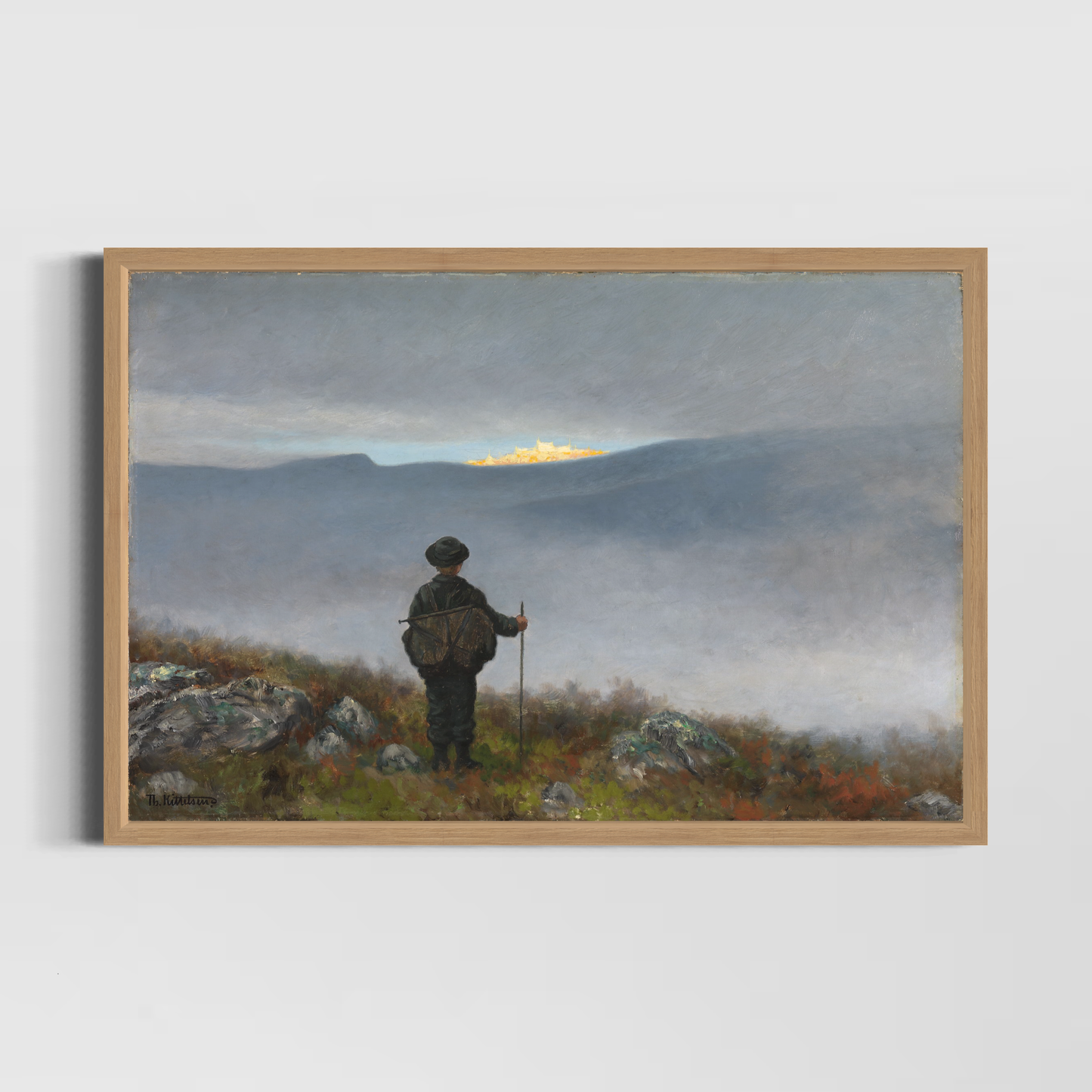
Far, far away he saw something bright and glittering
Far, far away he saw something bright and glittering
Couldn't load pickup availability
Experience museum-quality art from the National Museum's collection! Our Posters are printed on premium quality Litho White Matt (230 g) photo paper and feature a visible National Museum logo on the white border. Artprints are produced on exclusive Museum Rag (260 g) cotton art paper for an extra luxurious finish. Each print is made to order by Dáidda Printlab to ensure the highest quality and detail in the reproduction.
High-quality reproduction from the National Museum's collection.
- Posters printed on Litho White Matt - 230 gram photo paper
- Artprints printed on Moab Entrada Natural - 300 gram fine art cotton paper
- Matt surface
- Manufacturer: DAIDDA printlab
About the original:
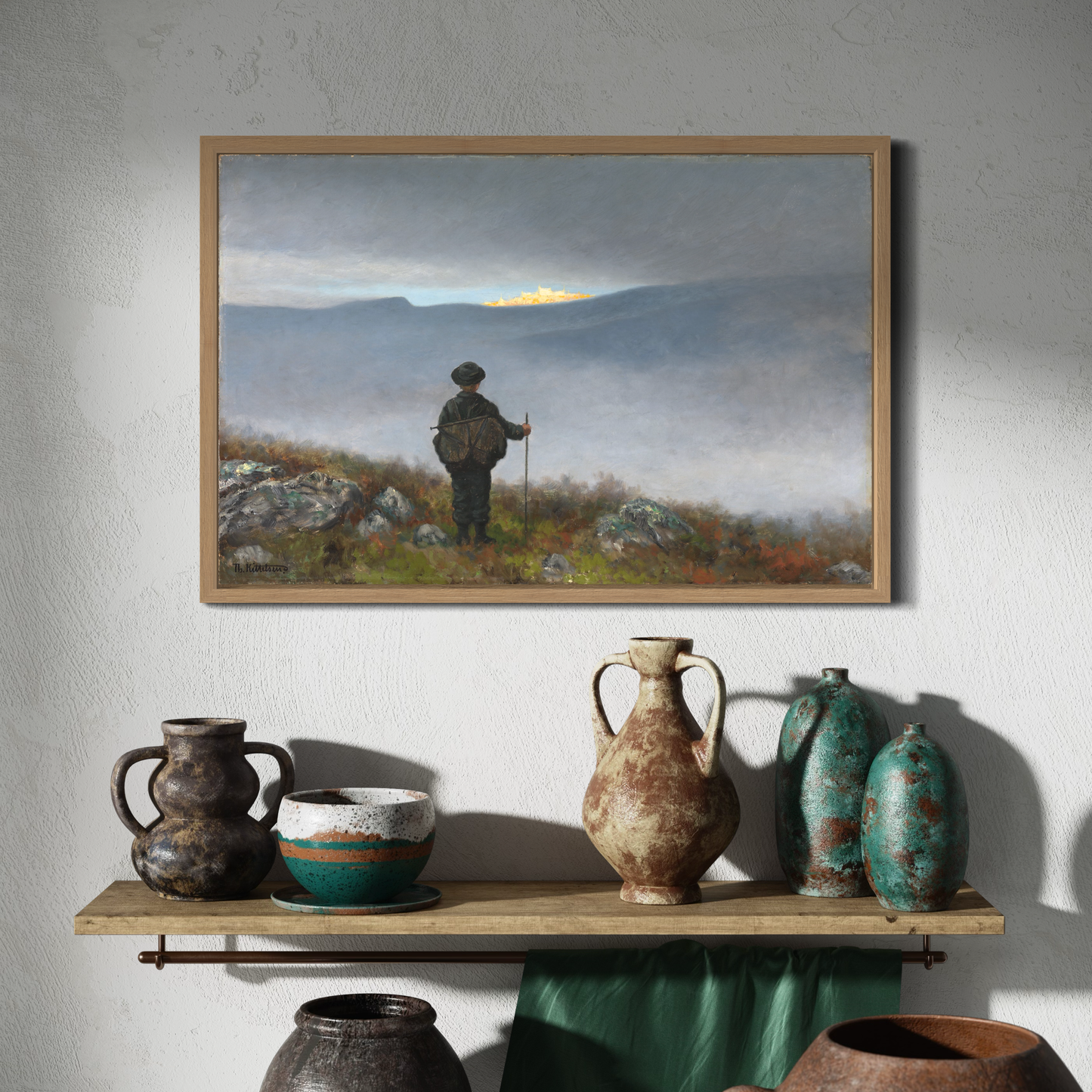
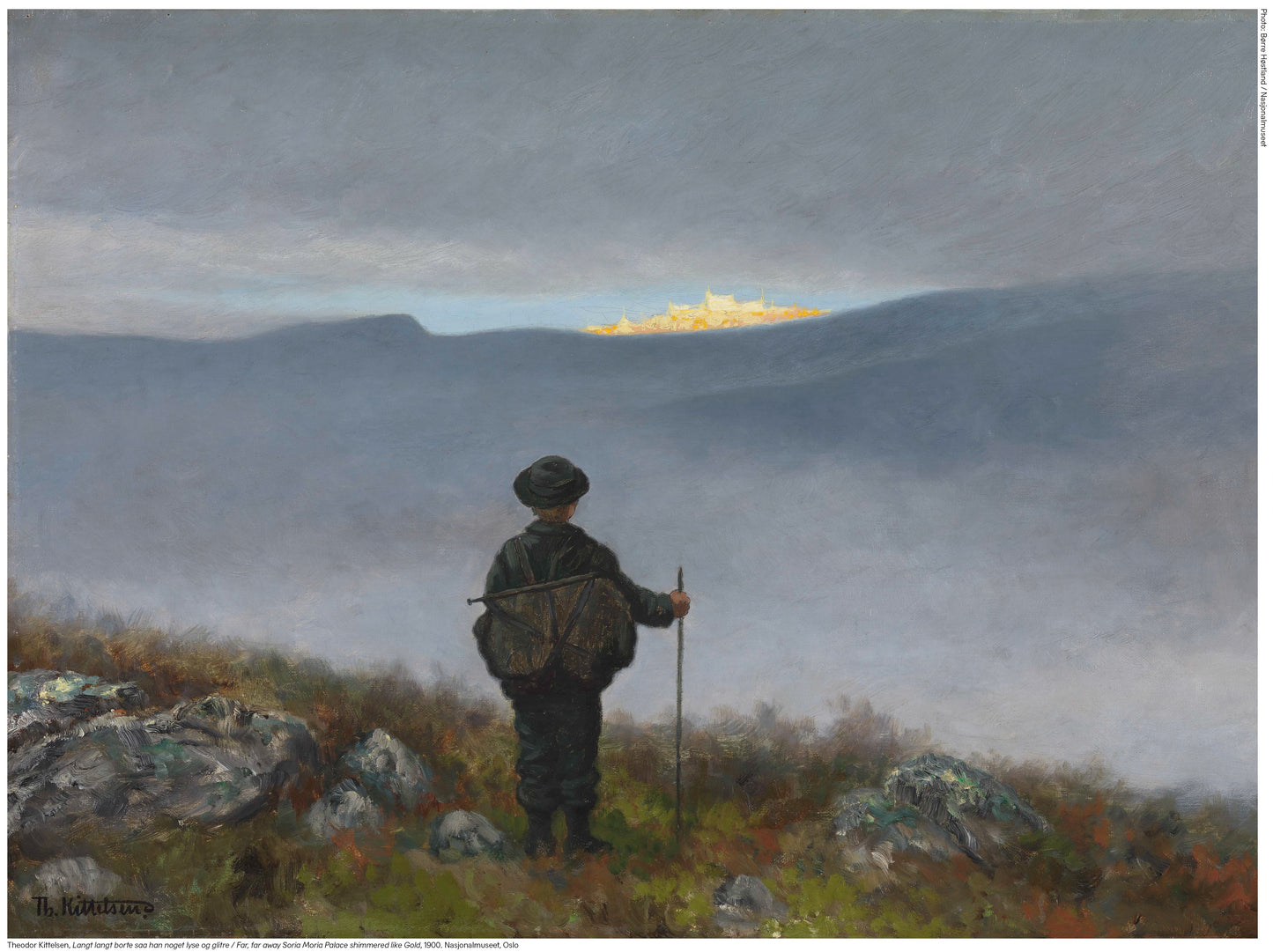
Theodor Kittelsen's representation of Askeladden who sees Soria Moria in the distance has become for many a symbol of hope for the future and the dream of success in life.
Finally, Askeladden sees his goal – the shining Soria Moria castle – on the horizon. Theodor Kittelsen says: "Then he had lunch in the old shack and went out into the wide world to find the castle. It carried over forest and valley, mountains and many blues. Far, far away something shone like a small star. Then at last he came nearer and nearer, and still further away, to the east of the sun and west of the moon, shone the castle of Soria Moria in shining gold." The painting has almost become a symbol of the dream of success.
The picture was painted in 1900 and belongs to the series "Soria Moria castle" which consists of twelve paintings. The illustrated children's book with Kittelsen's own text was first published in 1911.
He who dares nothing, wins nothing
The folk tale "Soria Moria castle" was first written down and published by Peter Christen Asbjørnsen and Jørgen Moe in the early 1840s. A good 15 years after Erik Werenskiold had created the first pictures for the adventure in 1884, Kittelsen painted his series and also created his own version of the story. All twelve paintings were exhibited at Blomqvist's and purchased by the National Gallery in the same year they were created. The paintings depict Cinderella's meeting with, among others, the bear, the dragon and the golden bird, while he is on his way to free the princess in the castle. The battle with the troll is inevitable, and the picture series follows the fairy tale tradition with a happy ending and wedding for the hero and princess.
Cinderella - hero or anti-hero?
You may know Cinderella from Theodor Kittelsen's drawings for the fairy tale "Askeladon and the good helpers" or "Askeladon who raced with the troll"? Or from Erik Werenskiold's drawings for "Soria Moria castle"? Many probably also think of Ivo Caprino's adventure films from the 1960s. Caprino's films are based on Asbjørnsen and Moe's folktales, and he was most certainly inspired by the drawings of his predecessors Werenskiold and Kittelsen. The films "Cinderella. In Dovregubben's hall" (2016) and "Askeladden. In Soria Moria slott" (2019), directed by Mikkel Brænne Sandemose, also has many recognizable features from older text and images.
It is not unusual for the Askeladd character to have other names in the folk tales, such as Espen, Tyrihans, Askefisen, "the boy" or "the youngest". In the original version of the "Soria Moria" adventure, the boy's name is Halvor. Askeladden is the youngest of three brothers who grow up in a poor farming family. Nobody expects anything in particular from him, least of all the older brothers, Per and Pål. Ashkeladn takes life in stride and dreams away while fiddling with a stick in the ashes. It turns out that he is neither stupid nor lazy as the brothers think. Yngstemann waits for the right moment and shows both prudence and action when he has to solve the challenges that appear on the road. Some people think that he has more courage than sense, but Askeladden might do well to think a little about the big and small in life by the fireplace before he goes out into the world? His solutions are often creative, and behind his actions there is always a kindness for the people he meets. It is also no secret that he always wins in the end. The reward is usually large amounts of gold and silver or the princess and half the kingdom.
In the adventure room in the National Museum, several of the paintings from the Soria Moria series are on display. In the Study Hall you can see several drawings from the museum's "treasury". These works are very sensitive to light and are therefore rarely exhibited.
Here you can read Theodor Kittelsen's adventure text and follow Askeladden on his journey.
Or read Asbjørnsen and Moe's original version of the adventure.
Date: (1900)
Title: Far, far away he saw something bright and glittering
Other titles: Far, far away Soria Moria Palace shimmered like Gold (ENG)
Designation: Painting
Material and technique: Oil on canvas
Technique: Oil
Material: Canvas
Dimensions: 45.4 x 68.8 cm
Subject: Visual arts
Classification: 532 - Visual arts
Motif: Landscape
Motif type: Fairy tales and legends
Acquisition: Purchased 1900
Inventory no.: NG.M.00546
Part of exhibition: Art 3. Works from the collection 1814-1950, 2007 - 2011
The dance of life. The collection from antiquity to 1950, 2011 - 2019
Kiss the frog! The art of transformation, 2005
Registration level: Single object
Owner and collection: The National Museum of Art, Architecture and Design, Visual Art Collections
Photo: Høstland, Børre
Delivery
Delivery
Pickup: You can pick up your package from us shortly. You will receive a pickup notification when it is ready.
Postal shipment: Delivery by Posten normally takes 2–5 days in Norway and up to 14 days to Europe and globally.
Packaging: All products are made to order and shipped rolled in environmentally friendly packaging.


See more works
-
Far, far away he saw something bright and glittering
Vendor:Theodor KittelsenRegular price From 200,00 NOKRegular priceUnit price per -
Pesta lists up the stairs in the house
Vendor:Theodor KittelsenRegular price From 200,00 NOKRegular priceUnit price per -
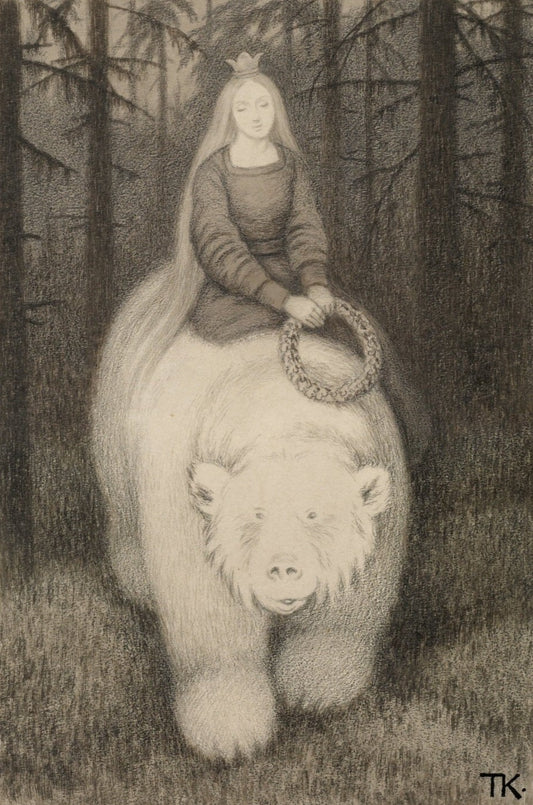
White Bear King Valemon
Vendor:Theodor KittelsenRegular price From 200,00 NOKRegular priceUnit price per



Theodore the tickle
After more than 100 years, Nøkken, Skogtrollet and Pesta are still icons in the consciousness of many Norwegians. Who is the artist behind these fabled figures? As a young man, Theodor Kittelsen wanted to become a painter, but there are signs that he eventually succeeded most of all. Here he finds outlet for his sense of humor and enthusiasm for anecdotes, fairy tales, comedy and, not least, for the magical in nature.
Kittelsen's pictures of Cinderella, trolls, princesses and animals have fascinated many generations. In Troldskab, the series which consists of a number of troll nature pictures with Kittelsen's own text, he personifies nature and the forces of nature that he himself experiences up close. The boy scouting towards the golden castle in the distance, from the painting series Soria Moria castle, has almost become a symbol of the dream of success in life. Nature moods "It's not the dramatic 'Effects' in nature that I care about. It is the mysterious Drag in it, the quiet, the secretive..." Kittelsen in Aftenposten, 9/10/1904. Kittelsen's close relationship with nature, not only the mysterious and secretive, but also the durable and evocative, is reflected in his drawings.
The drawings from Lofoten, which he made while living there, are among his main works. The same is true of the beautiful and tranquil watercolors from Jomfruland, which describe the bright summer landscape at the far end of the archipelago at Kragerø. He likes to start from realistic experiences of the landscape, but with elements of old folk tales he adds an extra dimension. Again, the works bear witness to the joy of drawing and combining different techniques. The younger Kittelsen is not fond of winter, but eventually he becomes very fascinated by rendering snow and snow-covered landscapes. Snow-heavy spruces with dompap or jumping squirrels turn into fascinating winter adventures. In the illustrations for Svartedauen, we meet a skilled series creator. Here Kittelsen combines historical material from the Middle Ages with his own attraction to the dark and melancholic in nature. Pictures, text and vignettes are based on anecdotes about rural people's encounter with the folk legend about the plague and death. Landscapes and houses in the series can also be traced back to various places where the artist himself has lived, from the farm Sole in Eggedal to Sund in Lofoten. Pesta's gaunt and crooked figure gives us a glimpse of the horror and fear of the past. By combining pencil with wash, charcoal and grease pencil, he enhances the atmosphere in the pictures.
Fantasy and satire Kittelsen is best known for the drawings of Asbjørnsen and Moe's folktales. Smørbukk, Kvitebjørn King Valemon and Ashkeladn who raced with the troll have a special position in today's image world as well. Caricatures and witty drawings are another circle of motifs he has been working on throughout his life. Here he ironises and teases people's quirks and pettiness, often with a sideways glance that also reveals his sympathy for the weak in society. The tick is also known for its sympathy with the animals and likes to give the animals human qualities, as in the animal fable Do the animals have souls? The museum's collection contains, in addition to the aforementioned painting series Soria-Moria castle of twelve pictures, a further seven paintings and some 260 drawings.