



Maria Giuseppe Crespi
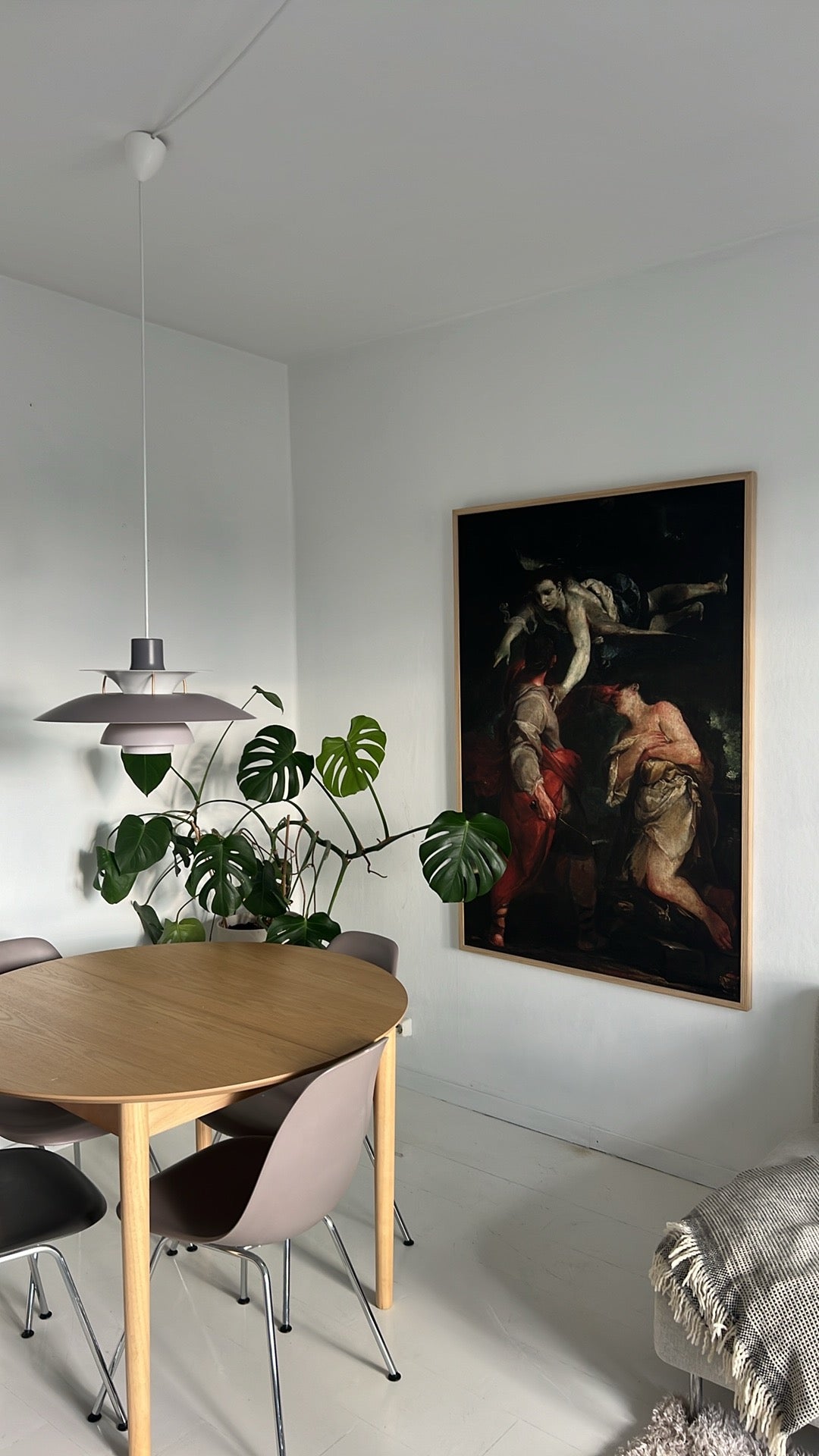
Abraham's Sacrifice - Maria Crespi Giuseppe (Framed 100x150)
Abraham's Sacrifice - Maria Crespi Giuseppe (Framed 100x150)
Couldn't load pickup availability
High-quality reproductions from the National Museum's collection. Posters by DAIDDA are printed on Litho White Matt - 230 gram photo paper in premium quality. Artprints by DAIDDA are printed on Moab Entrada Natural 190 gram cotton art paper in premium quality. Produced by DAIDDA.
Finished Framed Artprint - 100x150 cm
Add a touch of elegance to your home with our beautiful art print, printed on 100% museum quality cotton paper. This art print comes fully framed in our largest size.
The print is mounted on an acid-free backing board and framed with a natural oak frame that provides a warm and timeless finish. To ensure optimal viewing without reflections, the artwork is unglazed, but sprayed with UV protective spray for extra protection and long-lasting durability.
Product details:
- Size: 100x150cm
- Frame: Oak strip
- Backplate: Acid-free
- Protection: UV spray (no glass)
About the original:
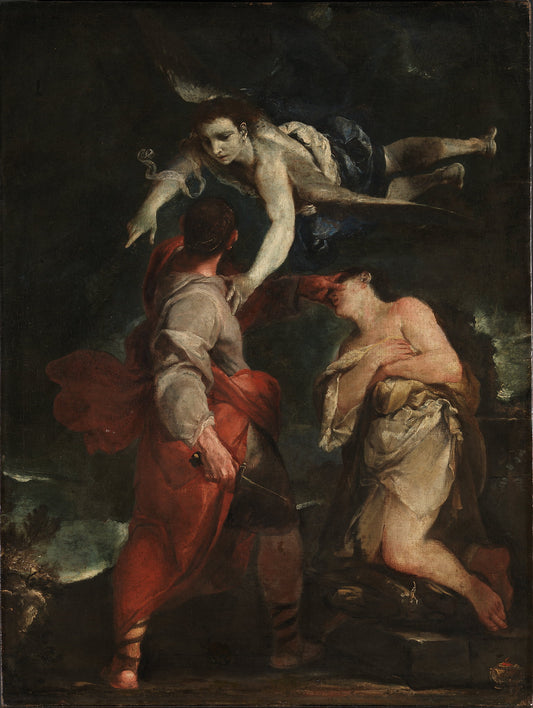
The Sacrifice of Abraham (original title unknown)
Dating: 1690s
Art form: Painting
Material/technique: Oil on canvas
Dimensions: 75 × 99 cm
Inventory no.: NG.M.03738
This painting depicts one of the most dramatic episodes in the Bible: Abraham's ordeal, in which he is commanded to sacrifice his son Isaac. The episode is a frequent motif in European art history, because it combines drama, religious significance, and possibilities for artistic staging of human emotions.
Stylistically, the work is typical of late 17th-century Baroque visual art: the use of strong contrasts between light and shadow, dramatic composition, and an intense emotional nerve. The light focuses on the main characters – Abraham, Isaac, and the angel – emphasizing both the violent moment and the divine intervention.
The painting's subject type is classified as a religious scene, with the subject word Biblical. This points to both the work's function as a pictorial interpretation of Bible stories and its place in a long European tradition of religious art.
The work was purchased by the National Gallery in 1987 and has since been included in several major exhibitions, including Older Foreign Art Before 1915 from the National Gallery's Collection (2007–2008) and The Dance of Life. The Collection from Antiquity to 1950 (2011–2019).
Today, the painting belongs to the National Museum of Art, Architecture and Design, Visual Arts Collections, and is included as a single object in the museum's registered collection.
Shipping and returns
Shipping and returns
Shipping: We deliver to Scandinavia, the EU, the USA and several other countries. Please contact us if your country is not listed and we will try to arrange delivery.
Delivery time: 2-5 days within Norway, 7 days in Europe, 14 days globally.
Packaging: Our products are made to order and sent rolled in environmentally friendly packaging.
Customs Fees: International orders may be subject to customs fees, which are not included in shipping costs.
Return policy: You can return images within 14 days. See our returns page for more information.
Secure Payment: We never store your payment details. See our privacy policy for details.


See all works
-
Abraham's Sacrifice - Maria Crespi Giuseppe (Framed 100x150)
Vendor:Maria Giuseppe CrespiRegular price 6.000,00 NOKRegular priceUnit price per0,00 NOKSale price 6.000,00 NOKSold out -
Abraham's sacrifice
Vendor:Maria Giuseppe CrespiRegular price From 150,00 NOKRegular priceUnit price per


Giuseppe Maria Crespi
Giuseppe Maria Crespi (born 14 March 1665 in Bologna, Church State, died 16 July 1747 in the same place) was an Italian painter from the late Baroque, associated with the Bologna school. He was known by the nickname "Lo Spagnuolo" ("the Spaniard"), due to his penchant for tight-fitting, Spanish-inspired clothing. Crespi worked in a wide range of paintings, including religious motifs and portraits, but he is today particularly known for his genre paintings.
Background
Giuseppe Crespi was the son of Girolamo Crespi and Isabella Cospi, and was distantly related to the noble Cospi family, which had connections to the Medici family of Florence. Crespi was nicknamed "Lo Spagnolo" by his fellow students due to his elegant and Spanish-inspired style of dress. He began his artistic education under the painters Domenico Maria Canuti and Carlo Cignani, and went on to study the works of masters such as Lodovico Carracci, Antonio da Correggio and Federico Barocci. In addition, he was a keen observer of nature.
Crespi diligently used a camera obscura to study light and shadow, as well as the people in the street, which characterized his paintings.
The paintings
Crespi's paintings are characterized by his experimentation with light and shadow, and he developed his own chiaroscuro style. He had an influence on other artists, such as Giovanni Battista Piazzetta. In his images of saints and heroic scenes, he often incorporated contrasting elements and showed a fondness for the mannered, even in shadowy parts and robes.
His works are known for their light compositions, powerful expressions and dynamic movement. Among his most famous works is the series "The Seven Sacraments" (exhibited in the Gemäldegalerie Alte Meister in Dresden), which was painted around 1712 for Cardinal Pietro Ottoboni in Rome. After Ottobon's death, these paintings were transferred to the Elector of Saxony. The series is recognized for its free brushstrokes combined with a sober piety, where Crespi uses everyday people to illustrate the holy sacraments using hieratic symbols such as saints and putti.